Nonlinear spectral unmixing, generalized bilinear model, endmember extraction, spectral variability, robust unmixing.
Nonlinear Unmixing Using a Generalized Bilinear Model
The generalized bilinear model (GBM) generalizes both the linear mixing model and recently introduced bilinear models by including second-order interaction terms between endmembers. A hierarchical Bayesian algorithm with Metropolis-within-Gibbs sampling ensures positivity and sum-to-one constraints.
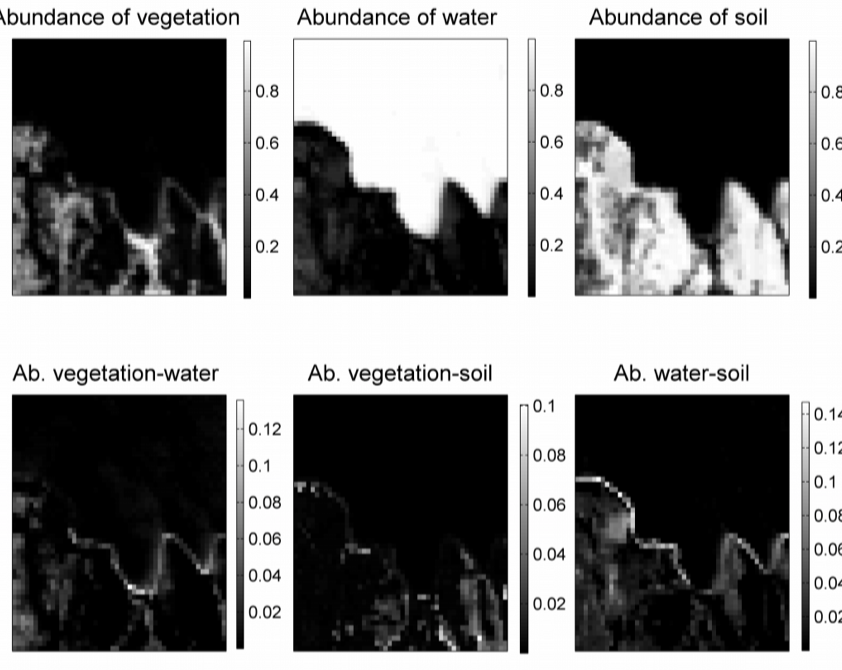 Abundance maps from GBM unmixing
Unsupervised Unmixing Accounting for Endmember Variability
This unsupervised Bayesian algorithm models pixels as linear combinations of random endmembers weighted by abundances, generalizing the normal compositional model. It estimates both mean and covariance matrix for each endmember, quantifying material behavior and variability across the scene.
 Spectral variability of endmembers across the scene
Unmixing in Presence of Endmember Variability, Nonlinearity, or Mismodelling Effects
Three hyperspectral mixture models with Bayesian algorithms for supervised unmixing. Based on residual component analysis, the general formulation assumes the linear model corrupted by additive terms accounting for nonlinearities, endmember variability, or mismodeling effects.
 Residual component analysis for robust unmixing
 Endmember variability and mismodelling effects
Fast Hyperspectral Unmixing
Two novel hyperspectral mixture models and unmixing algorithms. The nonlinearity model generalizes bilinear models by including higher order interaction terms. The alternating direction method of multipliers (ADMM) solves the convex problem with theoretical convergence guarantees.
 Fast unmixing via ADMM with convergence guarantees
Correntropy Maximization via ADMM
Correntropy-based cost functions provide robustness to outliers in hyperspectral unmixing, down-weighting large residual errors compared to standard least-squares cost.
Estimating the Intrinsic Dimension of Hyperspectral Images
The proposed noise-whitened eigen-gap approach achieves near-perfect accuracy across all noise overestimation levels, significantly outperforming existing methods.
 Noise-whitened eigen-gap approach for intrinsic dimension estimation