Hyperspectral Imagery
Nonlinear spectral unmixing, generalized bilinear model, endmember extraction, spectral variability
Generalized Bilinear Model (GBM)
The generalized bilinear model (GBM) accounts for second-order interactions between endmembers, capturing nonlinear mixing effects that occur in hyperspectral images. We developed Bayesian algorithms for the estimation of abundances and nonlinearity coefficients under the GBM, providing a flexible framework for nonlinear spectral unmixing.
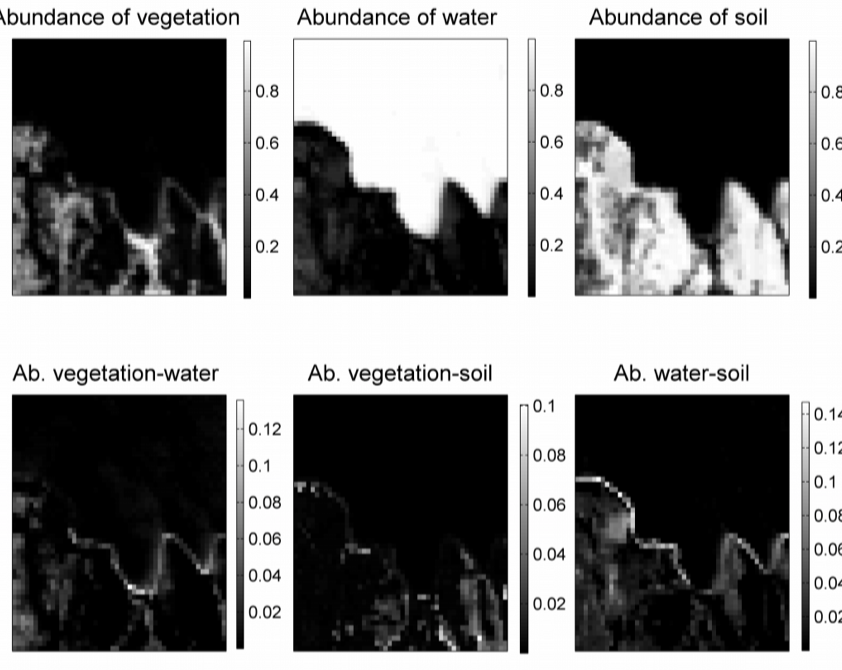
- A. Halimi, Y. Altmann, N. Dobigeon, and J.-Y. Tourneret, "Nonlinear unmixing of hyperspectral images using a generalized bilinear model," IEEE Trans. Geoscience and Remote Sensing, vol. 49, no. 11, pp. 4153–4162, 2011. [PDF]
Polynomial Post-Nonlinear Model (PPNM)
The PPNM extends the linear mixing model by introducing a polynomial nonlinearity applied after the linear mixing stage. We proposed a Bayesian estimation algorithm for the PPNM that jointly estimates the abundances and the polynomial nonlinearity parameter.

- A. Halimi, Y. Altmann, N. Dobigeon, and J.-Y. Tourneret, "Unmixing hyperspectral images using the generalized bilinear model," in Proc. IEEE IGARSS, 2011.
Unsupervised Unmixing
Unsupervised spectral unmixing aims to jointly extract the endmembers and their abundances from hyperspectral images without prior knowledge of the pure spectral signatures. We proposed algorithms that handle both linear and nonlinear mixing scenarios in a fully unsupervised framework.

- A. Halimi, N. Dobigeon, and J.-Y. Tourneret, "Unsupervised unmixing of hyperspectral images accounting for endmember variability," IEEE Trans. Image Processing, vol. 24, no. 12, pp. 4904–4917, 2015.
Endmember Variability
Spectral variability of endmembers is a critical issue in hyperspectral unmixing. We developed models and algorithms that account for spatial and spectral variations of endmember signatures, improving unmixing performance in real-world scenarios where pure material spectra vary across the scene.

- A. Halimi, P. Honeine, and J. M. Bioucas-Dias, "Hyperspectral unmixing in presence of endmember variability, nonlinearity, or mismodeling effects," IEEE Trans. Image Processing, vol. 25, no. 10, pp. 4565–4579, 2016.
Fast Unmixing
Computational efficiency is essential for processing large hyperspectral datasets. We developed fast algorithms based on optimization techniques and GPU computing for real-time spectral unmixing of large-scale hyperspectral images.

- A. Halimi, N. Dobigeon, and J.-Y. Tourneret, "Fast hyperspectral unmixing in presence of nonlinearity or mismodeling effects," IEEE Trans. Computational Imaging, vol. 3, no. 2, pp. 146–159, 2017. [Matlab Code]
Intrinsic Dimension Estimation
Estimating the intrinsic dimension (number of endmembers) of a hyperspectral image is a fundamental preprocessing step. We proposed Bayesian approaches to estimate the number of endmembers that account for both linear and nonlinear mixing effects.

- A. Halimi, C. Mailhes, J.-Y. Tourneret, and P. Honeine, "Bayesian estimation of the intrinsic dimension of hyperspectral images using a nonlinear model," in Proc. IEEE ICASSP, 2016.
Correntropy-based Unmixing
Correntropy provides a robust similarity measure that is less sensitive to outliers than the traditional mean squared error. We developed unmixing algorithms based on correntropy and ADMM that are robust to impulsive noise and outliers in hyperspectral data.
- A. Halimi, P. Honeine, M. Kharouf, C. Richard, and J.-Y. Tourneret, "Estimating the intrinsic dimension of hyperspectral images using a noise-whitened eigengap approach," IEEE Trans. Geoscience and Remote Sensing, vol. 54, no. 7, pp. 3811–3821, 2016. [Matlab Code]
- R. A. Borsoi, C. Richard, A. Ferrari, J. Chen, and A. Halimi, "Spectral unmixing with correntropy and ADMM," IEEE Trans. Geoscience and Remote Sensing, vol. 55, no. 7, pp. 3777–3791, 2017. [Matlab Code]