Medical Imaging
Functional MRI (fMRI), BOLD signal decomposition, sensor fusion, image segmentation
fMRI BOLD Signal Decomposition
Functional MRI (fMRI) measures brain activity by detecting changes in blood oxygenation (BOLD signal). We develop advanced signal decomposition methods to separate the hemodynamic response function (HRF) from neural activity signals, enabling more accurate mapping of brain activation patterns.
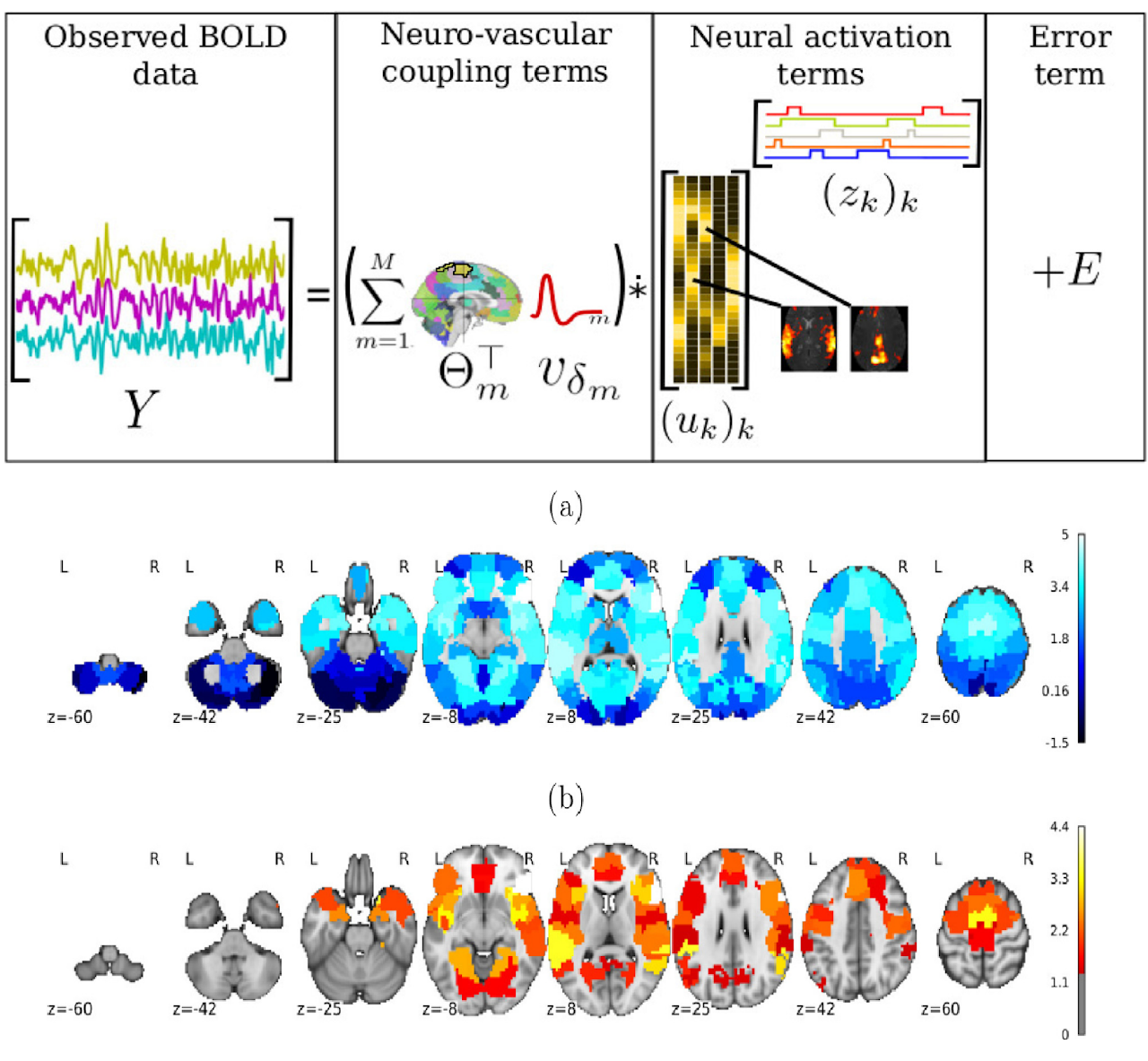
HemoLearn: Sparse Decomposition of fMRI Data
HemoLearn is a software tool for the sparse decomposition of fMRI data that jointly estimates hemodynamic response functions and activation maps. The approach uses dictionary learning with temporal and spatial sparsity constraints to provide interpretable decompositions of whole-brain fMRI data.

Sensor Fusion for Medical Imaging
Combining data from multiple imaging modalities can provide complementary information for improved diagnosis. We develop statistical methods for fusing multi-modal medical imaging data, leveraging Bayesian frameworks to combine structural and functional information.

Image Segmentation
Accurate segmentation of anatomical structures and lesions is essential for medical image analysis. We develop segmentation methods that combine model-based approaches with deep learning techniques to achieve robust and accurate delineation of regions of interest in medical images.

Related Publications
- H. Cherkaoui, T. Moreau, A. Halimi, and P. Ciuciu, "Sparsity-based blind deconvolution of neural activation signal in fMRI," in Proc. IEEE ICASSP, 2019.
- H. Cherkaoui, T. Moreau, A. Halimi, C. Leroy, and P. Ciuciu, "Multivariate semi-blind deconvolution of fMRI time series," NeuroImage, vol. 241, 2021.
- A. Halimi, H. Cherkaoui, P. Ciuciu, and S. McLaughlin, "Bayesian multifractal analysis of fMRI time series," in Proc. IEEE ISBI, 2020.